Sunday, September 08, 2013

Belated Bleatings from China


This with the travelator not working, a wall of intense heat, and a suitcase 

Arriving at Hong Kong Central station a passing Israeli and smoking cameraman both helped me find the gigantic restaurant where tuxedoed waiters showed me to the waiting Mara and Midori and a table piled high with roast duck and goose.  Midori generously insisted on mostly treating us and then took us up the long escalator from Chungking Express part of which was out of service, me dragging my suitcase and all of us (especially me) drenched in sweat.

Each human has his or her own private relationship with sweat the way each does with money.  In the same way you'll never really know the details unless they are particularly extravagant or you spend a long time in close proximity.

In a bar filled with Aussies and the odd Taiwanese (she really was odd) I had a pint of Stella for the first time since I was 16.  Didn’t feel like beating my wife.

The top of Victoria Mountain, aka “The Peak” is essentially a shopping center offering various ways to shed cash.  HK one of those cities where you can always physically look up at someone more successful than you.

Chungking Mansions was just how I remembered it from 2005, a huge complex of apartments, offices, shops, filthy, stinking, strangely alluring.  Corridors lined with curry stalls and electronic shops, half the city swapping currencies in black-market bureaux de change, and a mysterious cookie stall mobbed with crowds.  A sign told us you can’t actually buy biscuits there unless you purchase a ticket the previous night in a different part of the city.  We looked down at a woman stuffing 100 boxes into three large suitcases.  “Are they good?” we asked, pointlessly.

Through a clerical error we missed our 19-hour train from HK to Shanghai. Actually, it was just wild stupidity.  We fought like crazy in a sweltering corridor.  Old, wise-cracking ladies had seen it all before.  And worse.  Leaning over the side and peering into the huge open center of the complex you can see doors and doors all leading to cramped quarters where all kinds of unspeakable things must surely be going on, inhabitants oblivious to our screams of frustration and mutual blame emanating from the 8th floor.  Like an angel a Croatian emerged from a private room and acted as couples therapist and travel agent for a very productive ten minutes.  At the end of them we were 450 dollars lighter and had two flights for Shanghai leaving...  NOW!

A BAD CASE OF BEIJING BURNOUT

Guo Mao, Beijing, just one stop on a cackhanded journey to nowhere

Hazy buildings looming, endless high rises composing a spectral city.  I felt like I’d smoked 40 cigs a day for the past week—trachea closing, nose clogged, solidifying film of mucus, hacking cough.  Tried to get to the mythical art village of Song Zhuang.  Followed directions on CNN website.  Emerged in Guo Mao station to find bus terminal underpass closed off, thin light making its way down ghostly stairs and a stopped escalator behind a puddle of water and an ominous bucket.  Outside, a breathing trafficky rush of cars, smoke.  Progress.  To cross the road you have to go with faith...  Walk slowly and allow the vehicles to swarm round you.  Our balls weren't in the right place.  A team of guys with no English thought they worked out what we wanted and marched us a long way back to the metro where we boarded a long train to Songjia Zhuang station.  A busy mother with some English received us on the border of a gigantic flowing effluence of traffic.  You don't quite see across the roads.  The smog forms into cartoon movement lines as buses and juggernauts roar past.  “Wrong place,” told us a lady downstairs and how to get there—that's right, back to where we were—and a few stations later my blocked face rebelled and a cascade of snot pointed to an abandonment of our mission to the cool off-beaten art village that is way more in-the-know than 798 Art Village which is just SO commercialized these days (went the next day—not great unless you love over-produced paintings of kittens, empty warehouses, and expensive cafés).  Instead we changed course and completed the day’s ration of 3 hours in the subway by heading due northwest to the Old Summer Palace, chosen over its neighbor the (non-Old, current, new) Summer Palace because we wanted to see what is effectively a Chinese memorial to the ravages of 19th-century colonialism.  In the end during the burning midday hours we hauled ourselves around a broiling park humming deaf with cicadas and thousands of Chinese tourists.  Walking a path between marble ruins was like trying to stroll on the rush-hour subway.  

I was undergoing a process of Chinification.  Swiftly aggressive in seizing empty subway seats, I was generating huge quantities of phlegm demanding frequent hawking in public as well as coughing with no polite covering hand.  I hadn’t begun to sport the “Beijing Bikini” (rolled up t-shirt atop proud belly).  Only a matter of time.

Jumping into an ice-cold taxi to zoom to the infinitely better (second, latter) Summer Palace was one of those profligate decisions that has one weeping with joy.  A stupendous lake circuited by forest and strange towering pagodas.  Boats drifting into the distance looking lost in the magnitude of it all.  I wore Mara's riñonera (a term “liver thing” preferable to the horrendous “bum bag” and the unspeakable “fanny pack”) and she took my foldable sleeping-bag-material Muji backpack—a sign of my flailing condition.  Somehow the clumps of Chinese tourists were less suffocating here.  The sheer size of the place, the vastness of the lake, giving everything a subdued air.  Mara bartered with a charismatic old lady who taught us how to say “sugar” and “no sugar.”

The way you repeat a Chinese word back to a person causes them to repeat it back to you until you say it right which you generally do by exaggerating the tone making it sound like a deranged squawk at which point they laugh and give you the thumbs up.  You’re not sure if you got it right or you just reached a satisfactory level of comedic effectiveness.  Another time we tried the “sugar” thing at a different shop and failed miserably while the proprietor’s wife plied us with free pickled goods.  I tried it in every tone and I’m sure just by pure accident I must have said it right at least once, but was consistently met with looks of blank incomprehension.  Possibly because it was by then so far out of context as to be meaningless.  Might be like someone shouting “shoo-gay!” “shy girl!” “sham goo!” “shoo gar!”  “Why won’t this person go away?”  I would probably think.

Wheezing and limping around Beijing Mara and I tried to avoid killing each other and often failed.  It was like Twelve Angry Men except it was one angry couple and Henry Fonda smoking cigarettes was replaced with dense clouds of toxic pollution.

FAKING IT


In the beautiful colonialesque bubble of central Shanghai we took a small detour to the 3rd world in the form of the fakes market.  Wise young merchants emerge from closets to offer all manner of replica goods.  The best part is their shelving units have SECRET CATCHES that swing open walls Bond-villain style and reveal inner compartments lined with “the good stuff.”  This is either a safeguard against police raids or a sales technique—“Now I’m showing you the good stuff.”  I fought down the price of a wallet I didn't really want to 100RMB (about 10 quid) and with Engen and Mara on either side of me baying “You don't have to get it!” my zombie self kicked in.  I saw myself as if in a cracked old cinema print pulling out a crisp 100 and handing it over.  The deed was done.  The girls gaped at me.  I didn't even like the wallet.

This tragedy spurred me to put together the pieces of my life and buy another wallet.  (The second task was easier.)  A guy called “Ben” locked me in his back compartment where a combo of sales patter, bromance and heat-induced delusion induced me to pay the exorbitant sum of 35 quid for an “authentic” Mont Blanc leather wallet.  Ben even threw in a pen (the one I am currently using) “not as a business offer but as a symbol of friendship” and I emerged sheepishly to the horror and fascination of the ladies.  Not the first time I’ve elicited those reactions.

DUCK PALACE

In a south Beijing Duck Palace

Roast duck—is it that good?  Or is it the ritual that we enjoy so much?  The dipping into the gloopy sauce.  The slices of fatty meat that never seem to be worth their weight in duck.  Mara's university friend and his mother and wife and child were waiting for us in an obscure Beijing suburb in a hotel-cum-duck palace with a personal miked-up waitress in a kitchen buzzing up the food.  Turns out the spinning glass wheel gracing the tables of Chinese restaurants of my youth is actually alive and rotating in China.

Mara's friend works for the government in intellectual property.  He has his work cut out.  Apparently such duck palaces as these used to be crammed with functionaries blowing poultry-shaped holes in their expense accounts, but a unilateral decree from on high recently put paid to all that and the quacking emporia have had to slash prices.  Not a single bill joke.

He told us stories of Mao in the safe confines of the hotel room.  Like when he ordered everyone to kill sparrows one year to supposedly deal with a food shortage.  His mother occasionally smiled at us and put away a surprising number of pancakes.  A spicy mutton stir-fry dish that you stuff into fried buns was spectacular.

Then he took us for a foot massage.  The three of us lay as we were administered to.  The Yin and the Yang rule meant Mara had a burly guy and her friend and I both had petite females.  I felt the forces balance.  Our companion complained his girl wasn’t strong enough.  You want balanced energies—and a good massage?  A widescreen TV displayed a popular daily show where job candidates offer themselves to a panel of company bosses.  We had optional extras with the massage.  Mara got the hot cups on her back and I had my ears emptied with a candle.  He told me it sounds like the rain, and it did.  We became horribly ill the next day.  That’s what happens when you unleash the Yin and Yang.

SHANGALONG


Took about 6 taxis a day in Shanghai.  They were wonderful.  Stupendous architecture across the water in Pudong where we never actually set foot.  The Jewish Museum featured female university students with excellent English and astonishing knowledge about modern Jewish history.  Shanghai was refuge for tens of thousands of Jews.  Moving stories and the occasional jab at Japan.  “Germany apologized, reformed its society, and never forgot its crimes unlike other nations we could mention.”

For some reason we thought that a museum called the Urban Planning Museum was going to be good.  It’s in all the guidebooks and top tens.  Its centerpiece is a fairly fabulous scale model of the entire city which lights up occasionally. There was also a 360º tour of the city from a UFO-like observation pod.  Apart from that acreage of maps, diagrams and soporific details. We skedaddled as power rain began to pummel the city.  In the nearby Museum of Contemporary Art there was a mockery of the Urban Planning Shanghai city model made out of poker chips [pictured].  Better.

Staff formality on show at the Forbidden Palace, Beijing

Formality.  In Japan museum staff wear buttoned up jackets, trousers and black, shiny shoes.  They'll stand in their spot unmoving for the entirety of their shift.  Compare.  The museum staff were in shorts and flip flops.  They lay languidly gossiping.  Talked on their phones.  Slouched around without a care in the world leaving whole rooms unattended.  An art piece that consisted of 6 painted dartboards invited users to have a go, which we did until panicked and horrified museum staff came and told us not to touch.  I was amazed we actually managed to provoke a reaction.

In a central park some 100 parents offered their kids up for marriage in the form of classified-ad like posters stuck onto a wall.  The progenitors milled smoking and gossiping.  The kids probably didn't know they were plastered on a wall in a park as potential marriage material.  The ads were mostly hadn-written with marker pens.  A few had photos. Most didn't.  Some candidates seemed suspiciously affluent and/or good looking, hinting at some unspeakable hidden flaw.  Maybe they're gay and Ma and Pa never sussed it out.

JAPANCHINAJAPANCHINA


Using a police van for shade in Tianamen Square. Who said the cops aren't friendly?

Difficult not to go around constantly saying “In Japan this is the exact opposite.”  Pretty much everything is.  Noisy vs. quiet.  Aggressive vs. respectful.  Individualistic vs. community minded.  Dirty vs. clean.  Pushy vs. polite.  Toxic vs. clean.  Similarities: noodles and rice.  And some writing.

Your identity borne along on a torrential tidal wave of people and progress.  The rush exhilarating and monstrous.  It’s like the Total Perspective Vortex from Hitchhiker’s Guide to the Galaxy which drives you mad by showing how insignificant you are in the context of infinity.  In the context of 1.2 billion people my ego shrank to the size of a small packet of instant noodles.  Among hordes of Chinese tourists my mental expanse of hopes and dreams was a dust trail on a bus window.

Similar but expressed differently is the concept of FACE.  In Japan face-saving works in a roundabout way.  When a Japanese person says no to a request, you work hard to find a way in which he or she can comply help you out without directly going against the rule.  In China the face is plopped in your lap immediately like an unwanted Christmas present.  Taxi drivers go off on rants just requiring you to say they are right.

A nation with millions of only children.  Rules mean nothing.  Red lights are there to be run.

In Japan people go out their way to show you mean something.  The inclination of a head is obligatory to show you are even aware of someone else's presence.  In China you’re one of nothing.  Maybe I’m just speaking for myself.

But people in short moments were friendly, funny, helpful.  Hearts on sleeves, emotions out in the open.  Anyone who spoke English would approach in times of trouble.  In Beijing the response was muted.  Questions were typically answered with a raised hand pointing in a direction that could mean a range of things: “What you are looking for is over there.”  “In that direction is a bus stop.”  “Ask someone over there.”  “I don't know.”  “Get out my face fuckboy.”  Context is everything.

ART & FOOD
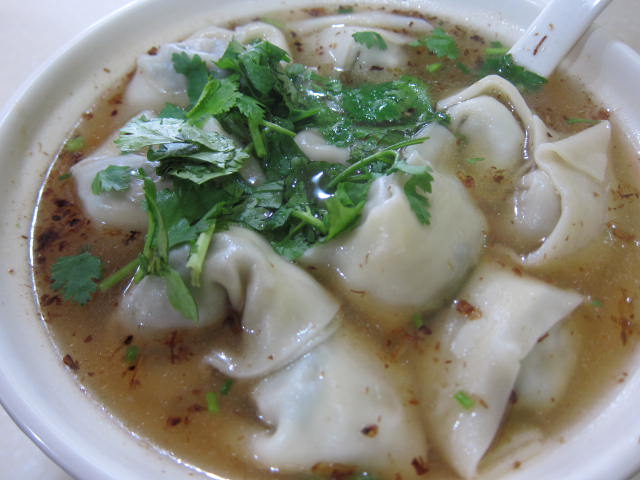

The food is another thing.  That’s opposite to Japan.  Refined, steamed, healthy are replaced by ladel-fulls of oil and garlic and chilli.  Psychotic levels of hygiene (notwithstanding radiation contamination) are replaced with a laissez-faire attitude to ingredient sourcing.  Organic food is present in China at least in the form of faecal matter.  Of course it’s bloody delicious at the same time.  One of the best a Shanghai hole-in-the-wall joint serving up soup with dumplings at negligible prices [pictured].  Another killer was a Szechuan multi-tiered restaurant in the trendy zone of Guo Mao in Beijing where we each received cauldrons full of diced fried vegetables, beef and chicken mixed with those cardboard-like red chills they like to add by the kilo.

Just as the cuisine was often better in the holes in the wall than the fancy restaurants, so was the art often better in the warehouse than the gallery.  The best of all was in the M50 art district of Shanghai, specifically an exhibition by multimedia artists group Liu Dao who put moving LED displays inside many of their works that reacted to the viewer.  One required you to pick up a light and shine it on the piece in order to elicit various sounds, others offered a video that reacted if you phoned a particular telephone number scrawled onto the screen in the form of graffiti. Little taster:

By Liu Dao, Shanghai M50

Thursday, March 22, 2012

Transient Destruction

Last night I went into the Talion Gallery in Nishi-Nippori, where artist Taro Izumi is curating an exhibition. I pulled one of the paintings—a blue one with a metal grill—off the wall and violently dragged it across the gallery space. Then I seized another one and hurled it at the ceiling, then several times against a couple of walls, making a hanging sculpture swing precariously. I sawed one in half after battering it for a while with the handle of the saw. I smashed, sawed and peeled a hole in another one so it could be thrown quoits-style onto my outstretched arm. I span one which was made of differently shaped rock-like slabs of polystyrene until all the parts flew across the room. I soaked one with a mini-shower that I manufactured with a water bottle and an electric drill, drew a crude representation of another one on the wall with red marker pen, and bit and chewed another one to pieces.

Worst, or perhaps best of all, they were all my artworks.

Or rather, my character John Bose's artworks. You probably guessed that this was all part of the exhibition. Izumi was filming each of my actions, instigating them by giving me the instructions (eat, throw, etc). What impacted me most—apart from the adrenaline and ridiculousness, and the satisfaction at smashing up a gallery like a rockstar in a hotel room—was that the video, which will contain parallel works by the other "artists" featured at the exhibition, will be projected onto the wall at the gallery for a couple of days, culminating the exhibition which mostly consisted of its own constant state of advancing destruction. Just a couple of days. There will be no repeat projections, nor will it be posted online. The artist has no desire to do either. This rootless transient statement will be made and hang there, before evaporating into the memory like the drops of water on my showered painting.

I thought of starting a Tumblr blog, so I can easily upload pics and shorter comments—maybe a more dynamic way of blogging. I guess this has been a solution for a lot of people who have let their blogs slide but find FB too annoying. Yet soon the Tumbl weeds will rot unused in the far reaches of cyberspace, burned out planets, graveyards of unheard thought. Are the bits of data flying around conscious of these tracts of desolate urban decay, as we would be flying between ancient hulks of spaceships left by an unknown extinct civilisation?

The Taro Izumi exhibition (apart from its expressions concerning the nature of art) hit me for its fuck you to the universally permanent nature of online things. 80% of which don't deserve to be forever, always slabbed up for all to see—though few do see them. Not many people will see this exhibition either, relative to the number of eyes in the cosmos. Perhaps just the people who happen to surf that way (Nishi-Nippori), hit that site (physical place) and link to it (tell other people). Funny how I'm writing about it here, on this blog I have neglected for so long. My need to tack my bit of tacky permanence to the enterprise. Who am I telling?

Thursday, March 17, 2011

Tokyo Apocalypse Diary


The rumours are conflicting. Some 600,000 people more left the City today, driving battered cars through the quagmire of people. I saw some guys on crutches dragging their bloody limbs off on the long road South. All they had was a flashlight and a sack of instant ramen. Some of the roads and bridges leaving the city have broken down. There are reports of some exit ways being clogged by bands of uniformed guards. No-one in, no-one out.

All supermarkets in Tokyo are sold out of bread and related products. Some sweet cakes can still be found. Pasta remains in certain places though. The locals seem unaware of its stodgy qualities. The 99 yen shop down the street was sold out of all instant ramen except a suspicious looking pot covered in flame drawings. I had to club an old lady with my bike chain to get to it, but I'm eating it now, crumbling it in my hands and licking up the grease. That could last me another 24 hours.

I've been boiling water and adding mouthwash to it instead of iodine, which is hard to find since the pharmacies were looted. I'm concerned that my sixpack of Listerine "Cool Blue" won't last the week. Milk and dairy products are to steer clear of. The putrescence of the cow population is common knowledge. "So fresh you can hear it moo" is no longer comforting.

What will happen when the food runs out? I've been reading Cormac McCarthy's The Road for recipe ideas. I just opened the window with my head in a paper bag to catch the definite whiff of burnt popcorn. What's going on out there?

The bread stockpiling is a mystery. Not a single egg can be found either. Secret French Toast parties. Probably the brain-addled freaks of the northern sector. It makes me sick to my stomach, but all I can retch up is a green, oily substance that reminds me of when I used to smoke Royals.

On the way back home today the subway broke down and we had to get out and push. All the men in their identikit black suits and the ladies with their shopping bags. The suits are filthy, have been for days, the shopping bags empty. People carry on.

Messages are sent through social networking sites. People who I haven't seen since Kindergarten urge me to flee. Don't they understand it's too late? The poison in my system has to be sated by continued ingestion. Or my organs will collapse. I read it on the BBC.

The wound I sustained during the Quake has start to glow faintly. I used it to heat up my last apple and then sprinkled it with the last of my cinnamon.

Better order pizza tonight.

Friday, March 11, 2011

Quake and Bake - Shinjuku Fallout

I just got back home at 9:10am, 18 hours or so after the Quake, to find the fridge had journeyed to the center of the room and a sprinkling of shelf contents on the floor having bounced off my computer. Working backwards, there was a cold sunshine bike ride back from the station, a horribly packed and painfully slow train journey on the first train, some long waiting, a nocturnal ramble, a witnessing of the insane fallout when an urban machine goes haywire.

I was in Japanese class when it started, leaning back against the flimsy interior wall. I have had a few minor quakes here so was quicker this time to realize it was not a machine dryer on in a nearby room. At first everyone giggled - small quakes happen all the time and are fun. But this was already too much. The earth heaved to and fro like the deck of a ship. It's very unsettling to feel the terra not firma. I remembered the old maxim and placed myself in the doorframe. It might have worked if I wasn't barged out of it as everyone escaped in a mad panic. Outside the sun shone and drivers stood by stationary vehicles. Suited businessmen milled on the pavement. Japanese girls were witnessed without make-up - a once in a lifetime opportunity. Small dogs were comforted. One ran round in very small circles looking like it might explode. A distinct odour of sulphur in the air - was it Japan's geothermal water table or a burst sewage pipe?

Aftershocks bubbled for an hour. Sometimes you thought you'd felt a tremor and had to look up at the buildings' antennae, or the rocking trees to be sure. Phones were inoperable, classes, work, trains were cancelled, some people went bravely off on bikes. Buses moved by packed with people who already knew they had to get out of the city any which way - and fast. The organizational fallout had begun.

Streams of people filled the avenues, haemorrhaging in all directions. Worried faces were outnumbered by ones happy to be off work early. Hundreds congregated outside the many exits of Shinjuku station, trying phones again and again, looking lost. Squadrons of uniformed guards stood in front of every box or ticket gate, patiently answering questions from the onslaught. Every public telephone had at least 20 people waiting to use it. A vindication of old cable technology. In a pub images of destruction appeared on the screen and punters bedded down for a long wait.

In a sushi place I chatted with a guy whose office was on the 38th floor, which had led to chairs being thrown about. He wanted to talk about Premiership football and insisted on paying for my meal as a point of samurai honour. I decided to try make it home.

I bumped into an Israeli friend heading back on foot. He lives one stop away from Shinjuku. My place was at least 3 hours walk away in uncertain directions.

Walking through one side of the massive conglomeration that is Shinjuku station, thousands of people stared helplessly at closed ticket gates, repeatedly asking the same questions of the guards, sitting on the floor to wait all night. Would trains be running later? No. Tomorrow morning? I don't know.

The bus terminal was comical. Every stop bore a queue stretching downstairs through tunnels to curl around the bowels of the station. No buses were turning up. I pulled off a coup by finding a little-known bus stop with a mysterious route direct through to my neighbourhood. But it all turned out to be a cruel hoax.

The patrons of Shinjuku's million tiny bars had the same silent glumness they always have. It was difficult to tell the difference. A street tout from Togo invited me on a little tour of some bizarre places ending up in a weird subterranean R&B bar where he unexpectedly produced his father and brother. I sneaked past the check-in counter of a karaoke place and into a recently vacated booth where I slept comfortably for a couple of hours. By now it was 5:30am - time for the trains to start?

People slept, stood, stared with glazed eyes. Japan Rail's finest were maintaining a solid defensive line against an increasing multitude. Complex messages were communicated via megaphone. I don't know how long I stood there, at the front, watching these bizarre procedures go on. Stretches of yellow tape were stuck here and there. Pieces of paper were moved around. A tiny woman in an air hostess get-up would come over now and again to the yellow hard-hatted guy with the bearing of a lieutenant. A big guy in a suit strode around looking menacing. In their Japanese way, the masses silently waited. Astonishingly, one guy started shouting complaints at a bespectacled guard in a comedy Gestapo uniform. Everyone was quietly enthralled.

When the floodgates opened it was all elbows. My pass didn't work so I kicked my way through the barriers. No-one cared. And up on the platform was Heaven's First Train. Implacable and gleaming, closed doors cruelly keeping us in the cold but nevertheless, magically there. The means of escape. A bedraggled man next to me touched his hand to the metal, softly, with love. Half an hour went by until we could stuff ourselves on and inch along the line at 5mph all the way home. The urban machine was functioning again and as I rode my bike back I was amazed to see people starting their Saturday where they should have been after all.

Saturday, February 05, 2011

Hot Springs and Hope Springs


Masks

There's something deeply sad about the city or it might be the winter. On a one-to-one level people are fantastically warm and friendly. As a grand movement there is something frozen and lost. On the train the stares and mouths drooling open. The eyes trained on phones, games. The shuffling, the face masks. It's enough to make you freak at times. Big cityness in all its impersonality.

More inspiring face masks could be found at the Setsubun festival in Shimokitazawa. It is a festival that celebrates the coming of Spring even though it's still plainly winter for another six weeks. Still, it gives you hope. Little children in devil masks threw soy beans at men dressed as devils. The littler ones wept and screamed with fear while their parents laughed. A good way of bringing trauma into normality at an early age. The soy beans were quite tasty and would make a good bar snack. But no-one else was eating them, preferring to lob them at the devils and then crunch them under foot until the streets were dusted in brown powder.

My coat burned to a crisp in a little bar in Asagaya where the barman supposedly plays Beatles songs on his guitar sometimes though that was during the holiday period and now when we were there it was definitely not of a holiday atmosphere and the coziness was provided by small electric braziers which were rather close to the customers, which is why my coat caught fire. By the time the thick smoke had become too invasive to ignore, the barman and some wrinkled regular were already in the doorway beating the fire out with vigour. I used to have a whole coat, and now I have a coat with a hole.


Onsen Mania in Nikko

We went to Nikko famous hot springs area to "take the waters." The hotel was fabulous and our window gave onto an enormous lake encircled by snow-capped mountains. The view from the milky mineral and viciously hot water was a cement wall. There were lumps of snow and icicles around, which were something to look at, but Mayumi was upset. Though not by the food which was elaborate Japanese gourmet style, with hundreds of tiny tidbits such as sea urchin pâté and sea cucumber, roe, sashimi on a plate made out of rock salt, beef stew, a DIY shabu shabu involving big red fish with large eyes and a "risotto" that was basically an eggy-rice soup cooked in the old shabu shabu water. We sat in yukata robes and felt imperial. The whole being naked in the onsen thing is okay. You have a little towel that David explained was a "modesty towel." Still you could catch glimpses of other men's knackers if you so desired. There was an incredibly thin man whose entire back was a bone and had no bottom.

The procedure is: go in, sit on a stool and wash yourself thoroughly with a high-pressure shower. Try not to think about the history of the plastic stool you're sitting on. Get in the various hot spring baths available. The one outside here was searingly hot and unbearable while my feet and hands were inside. I had to balance my feet out on the wall and use my middle back as a fulcrum to keep from drowning. It was quite effective.

Onsen etiquette seems to forbid chatting with strangers, at least in my experience. And also if there is more than one pool, you might want to move along when someone else comes. At least that's what everyone did when I turned up. But maybe that should be telling me something.

Monkeys and Dragons

The famous world heritage site Toshogu temple had lots of construction and an world heritage-worthy price tag. There was a big black and white dragon swooping around on one of the interior ceilings constructed to give out a ringing echo when a monk smacked two sticks together underneath it which one kindly did for us four times. The snow was deep everywhere and weathered men shovelled it with multicoloured spades. The three monkeys of "see no evil..." fame were carved in bas relief on the front of one temple. A parable of blissful ignorance, if you can get your three monkeys coordinated, which seems a bit of a tall order. Better off giving them typewriters and waiting for them to produce the Complete Works of Danielle Steele.

Mara and I continued to Kinugawa Onsen, a set of concrete blocks in the middle of a ring of snowy mountains. We ate lousy pasta and for the same money got the run of a huge hot springs emporium with eight baths for men and separately for women, including jacuzzis and one freestanding copper tub that I didn't go into because it had been recently vacated by a fat old man. The outdoors ones were something. On a promontory extended into the wide valley, sitting in the 42ºC rock bath, the snow fell thickly all around. I closed my eyes and emptied my head to the rush of the water and the patter of the falling snow.

Hermit Holes

Those crazy little bars are limitless. Going for these bars requires a leap of faith. Scaling stairs that would look especially dangerous and urban in the middle of Hackney can lead to a lush emporium of swish chairs, cocktails and elaborate decorations, or a small dark corridor filled with mumbling men. But how are you to know from the 30 year old battered neon sign outside? Answer: you're not.

Up on a fourth floor up some horrible steps, behind a door with no sign, we found a little red place packed with hanging musical instruments, chandeliers, birds, old telephones, an avalanche of period props. There was enough room for probably five people but our arrival pushed it to ten and the warm convivial atmosphere was an excellently-decorated rush hour subway train that's not going anywhere and doesn't want to. The barman put on some jazz - and then I realized that it was he, playing on an upright piano under the bar.

Then there was that place, Mother's Ruin in Shimokitazawa, with a gigantic dragon-cum-lizard on the ceiling, made of solid gold and threatening to crush the drinkers in case of earthquake. The toilet had handpainted wallpaper showing scenes from the Ramayana or something like that. I had a hot rum with a knob of butter floating in it like it couldn't care less.

Flowers on the subway. Tress in winter dress. Empty branches. Cold frozen ground. Plum trees blossom in the center of the university campus. The days are short and blue and very sunny. The air is dry and originates sometimes in Siberia.

Monday, November 15, 2010

The Information Super B-Road


Going to the immigration office in Tachikawa yielded an important discovery. We are surrounded by LARGE URBAN CONGLOMERATIONS. In ALL DIRECTIONS. And here I was thinking we lived on the outskirts of the city. No, though this terrain is littered with allotments sprouting unidentified fruit & veg, it seems this is just a resting point before more unbridled urbanity.

And these aren't like small suburban centers in London with a few Tesco Express stores and a grubby pub. Each one has a couple of high-rise department stores, several concrete runways and four billion restaurants. I've been into these high-rise department stores driven by curiosity and other basic human necessities. Often they are divided into sub-buildings arranged according to two or more of the cardinal points, each with their own unattractive elevators and a varying number of floors. Some parts of the building go to the 8th floor, some go to the 6th. How do they do it? Vast expanses filled with merchandise and just a couple of scattered people looking as bewildered as me. How do they stay alive? Along with the billion restaurants, shops, tiny bars... HOW DO THEY DO IT? Many times walking the streets you'll glimpse a small window whose immaculately arranged curtain betrays a tantalizing glimpse into some congenial little parlour with a counter and stools arranged for some kind of mysterious eating purpose... The towers above you bear signs advertising all kinds of restaurants on any floor from 3 below to 7 up, bars with names in kanji, and hiragana characters, the occasional English word thrown in to shed no more light on what they are actually like, on how much time, how much money you need to find them all... What are you missing?


A new friend of a friend and his friend and I went on an outing with a charming group of older but astonishingly active Japanese people on their English conversation group outing, one of whom was the friend of a friend's friend's mother. We travelled out the city to a small town whose main tourist attraction was a museum to Japanese film character Tora san. His films are like a Japanese version of Carry On, i.e. cheesy old comedy films that they squeezed every last drop out of. Amazingly the conversation crew was content with standing outside the museum and chatting for a little while before going off to have tea in an exquisite traditional house. My new friends and I rebelled and entered the museum to find ourselves confronted with fantastically detailed miniature models of Tora san's common film sets. His 48 films all had the same plot and involved him falling for a woman only to wind up a heartbroken vagabond yet again. When the poor actor was riddled with cancer the pushy producers forced him to make one more film in which he spends most of it sitting down. Then he died, and so did the film series. Sad, isn't it?

We crossed the river into Chiba, thereby leaving Tokyo. We inched silently across the water's breadth in a wooden gondola crammed with people. Everyone was sunned into momentary silence. The water was still and thick; the dying summer heat pounded us with a large polystyrene mallet. The craggy boatman turned his stick with ancient patience. We were crossing into oblivion and it was warm. On the other side, we climbed up the dock and found various fields rolling off into the distance. What do people come here for, I wondered? We crossed a field and mounted a hill where an old man sat on a deckchair wearing a hat from the Australian Outback. He got up and so began one of the features of Japanese society. Old people with information.


While the young and not actually that young are plugged into the information superhighway, so the over-60s in Japan (who seem to be less technologically savvy than their Western counterparts) are plugged into a kind of information B-road. Weekends are filled with club activities for the retired. Married couples split up and pursue their personal activities, be it English conversation (in this case), rambling, golf, etc etc. As you amble about you will come across local old people who are lying in wait to ambush you and spurt information in your general direction. It kept happening. At a temple a volunteer tour guide approached us and proceeded to spend the entire day following us around giving lengthy sermons, that were translated to me differently by each person I spoke to. When we crossed the river I thought we'd lost him but sure enough when we returned he was there, wagging his tail and panting in his luminous orange "I'm a volunteer" jacket. The old man in the Crocodile Dundee hat awaiting us on the other side of the river, as if in some unspoken relay with Tail Wagger, spoke interminably about the history of the small patch of ground surrounding us. Some said he was talking about an old horse-riding college. Others said he was talking about rice crops after the war. But whatever it was it was long and slow and when we walked away I took his photo and he was embarrassed.

The Five Starbucks of Kichijōji

Kichijōji is an excellent area, let down only by it's gangrenous proliferation of Starbucks. I have counted five up to now, though I'm always ready to spot another tucked around a corner like the malignant boil behind a giant's ear. Time for a lancing.

- There's that one on the path down to the park by the famous yakitori place that billows with smoke and was on TV once apparently.

- That other one on Nakamichi shopping street near the curry stench of Café Montana and the best rāmen place in the world.

- Oh, what about that one on the other pedestrianized street just by that butchers that always has a queue outside it? Opposite Tokyu that huge department store I've never been in?

- And yes, above the station in that classy shopping center near the chopstick shop.

- Ooh, what was the fifth one. What was it. Oh yes, round behind on the other side, near Zara - you know, the one with the huge wooden deck.


So it turns out rāmen is unhealthy. Who'd have thought it? Must be that oily soup.

Saturday, October 16, 2010

Signs and Wanders

Japanese conversation is punctuated by shrill and constant expressions of surprise. Mention that it rained yesterday in Britain, or some other statement of banal fact, and you will receive a breathy, Yoda-like "Ah, sodeska?" as if you had just stated the percentage of gay people in the Chinese government or something actually interesting like that.

My personal favourite is a singing gasp that rises in pitch and volume to a teetering precipice of stunned amazement. You might achieve such a reaction from stating that last year you had a cold, or making a shrewd observation like "Ooh look, there's a bird." Aaaaahhhhhhh!!!

How they Fuck you Over

Gently, calmly, so you don't even notice. It's subtle and, dare I say it, almost pleasing? Nothing at all like the crude violations perpetrated on you in Argentina. When you're being fucked over by a monopolic telephone company in Buenos Aires, you have a bird's eye view of your own rough penetration. In Japan it's more like being given a massage by a stranger on a crowded subway. And the subway is a great example. You load up cash on your magnetic card, and as you beep in and beep out, thousands of dollars fly out invisibly and unnoticeably like a gas leak in the house of a coma victim.

City of Water & Peace

Hiroshima is a relaxed paradise of interlaced rivers, trundling trams, friendly folk and stacks of adorable bars. The Peace Park, where the BOMB dropped, is one of those hyper-designed concrete and grass spaces that smooth out the kinks in your soul. It's studded with memorials and through its heart runs an axis from the centre of the wide museum building through a bizarre tubular memorial arch to the awesome A-Dome. A former municipal building whose frame and distinctive dome structure were somehow left standing by the nuclear explosion that occurred just above and to the left of it, it has been preserved in that condition as a reminder, and it is chilling to the bone.

The Museum is a 1950s building and its current contents might have seemed state of the art back then. It makes woeful use of its uniquely powerful subject. It's still hugely affecting to see the debilitating destruction caused through scale models of the city, bottles welded together by the blast, examples of the nuclear shadow and horrific human evidence of the deadly radiation. But the exhibition has poor lighting, antique displays and a 1 minute introductory video whose bellowing soundtrack of voiceover backed by strings accompanies on loop your entire journey round the museum. Put it in a box, guys. Why not phone Spielberg and ask him if he fancies taking a break from designing Holocaust Museums?

Future Perfect

The funny thing about the Hiroshima Museum's exhibition is that it probably looked futuristic once. Which is the case with most of Tokyo. It is like the futuristic city as envisaged 30 years ago by some delirious weirdo in a basement. Except shabbier. It's like the alternate 1985 that Michael J. Fox travels to in Back to the Future II. You know, one where he doesn't have Parkinson's. It's the bricks and mortar equivalent of verb tense the Future Perfect. It will have happened. Or rather some kind of bastardised version: It will have been going to have been happening. R.I.P. Douglas Adams.

For Pity's SAKE

At the Sanjō Sake Festival among banks of crates bearing over 900 varieties of the ol' rice wine, I met RICKY. A gigantic African American 57-year-old with a suspiciously non-specific job in the US Government that has led him to work in various bizarre locations around the world, he regaled me hilariously as we chucked down shots from our tiny cups. Let's face it, most of them taste the same. Even a Japanese guy said that, so I'm not being racist. Finally we learned the word 'karai' (dry), which unlocked the door to the good stuff. Ricky and I met up again the next day to go to Miyajima Island, a beautiful pile of forest and rocks out in Hiroshima Bay. It's covered in deer, oyster vendors and fascinating machines that pump out Hiroshima's famed cakes, which are maple leaf-shaped. Yes, that's right. Hiroshima is from Canada.

Friday, October 01, 2010

Dock this

The London docklands seemed a tiny, perfect concrete adventure playground. Buenos Aires port, once the conduit for a continent's wealth, was reminscent of a couple of scattered building blocks. The Tokyo docks, in their wide inconceivable vastness, lay before us.

Our mission: to collect items shipped from London two months earlier.

Several different subway lines and a monorail that coasts along a riverside deposited us two hours later before the yawning impersonal greyness of DOCKLAND. Giant buildings in the distance loomed like some kind of industrial Mordor. We trudged through sticky humidity, through a landscape not intended for pedestrians. In fact, we were the only ones. Trucks and shiny lorries sped past. We passed large empty parks, tracts of greenery supposed to relieve the desolate wasteland, but in fact making it all the more desperate. Like trying to tackle India's starving children with one bag of doughnuts.

Hours of hunger and thirst staggered by. No friendly bedouins about to toss us a canteen of water. We found ourselves in a dizzying wonderland of multicoloured cargo containers. Memories of The Wire Season 2 flashed before our dilated pupils. Could one of them be filled with dead Ukrainian prostitutes? Chance would be a fine thing. Several attempts to get directions resulted in blank looks or, worse, lengthy, tortuous attempts to answer a question to which it was quickly apparent no-one knew the answer. Awkward silences ensued. In-fighting sparked up. Where would it all end?

And then we found it. Seino Logix. A boxy office wedged in the crevice of a warehouse complex the size of East Anglia. Who were these people? Port handling, cargo collection? Import middlemen? Not sure. We had already paid the shipping company but this was a separate matter, apparently.


Those who have seen Kurosawa's film Ikiru, a critique of Japanese bureaucracy made in 1952, will be surprised that in 2010 the offices look EXACTLY THE SAME. Stacks of papers and dreary resigned facial expressions. There were no computers in 1952 but if there were you can be sure they wouldn't have been changed. Antique IBMs of that nondescript dirty grey colour and gigantic prehistoric monitors. Japan is not the hi-tec paradise envisioned by generations of manga artists. People bustled around fending off all work thrown their way like cartoon ninjas using breakfast trays to repel shuriken stars.

First we were charged US$ 140. More than we'd paid for the shipping. Why? Seino Logix had been kind enough to transport our stuff to their office and issue the paperwork. It's true the paperwork was obscenely copious but printing costs don't really come up to that sum. Well the transportation then - it would have been extremely useful had we not discovered we'd have to transfer it back to Customs ourselves to get it inspected.

Remonstrations and exasperated protests were met with repeated apologies. The Japanese apology, extremely apologetic in tone, actually has "Fuck you" as its rough translation.

Ok, we have to take the stuff that we've paid to have shipped here to Customs ourselves. Fine. It's a hassle, so just give us the stuff and we'll get it over with. No, you can't have the stuff. Why not? You have to go to Customs to get permission. And then come back to get the stuff. And then go back to Customs to get it inspected.

So what are we paying you for?

You'd better pay or we'll torch your boxes of crap and piss on the cinders.

Oh right, sorry.

A whole day passed in toing and froing through the docklands with and without enormous boxes of stuff, convoluted taxis, nowhere to buy food and but a setting sun over a monochrome horizon to elevate the spirit.

Wednesday, September 15, 2010

Silent labyrinth heralds rebirth

The bewildering whirr of the cicadas assaulted my senses. A Japanese symbol of rebirth, their dentist chair noises made me feel as if I were undergoing some kind of reincarnation operation.

It was my first night and we were hunting in vain and in the darkness for my bike I'd never seen, left in some place on the kibbutz-like university campus by an undefined friend. A guard approached with his torch: were we thieves? We weren't. We trudged away on foot to the apartment we were to stay in for a month. Or tried to.


Much of the area of Mitaka city is a suburban labyrinth of tiny houses with a veiny network of small alleyways bearing a constant stream of bikers and the occasional boxy car. We asked for directions in a faux 7-11 with a chicken logo and after intently studying a map found our destination.

Tokyo addresses are a code of numbers referring to sequentially dwindling areas of importance. Head backwards through this one:

1-29-17 Koganei, Higashicho, Mitaka-shi, Tokyo-to, Japan, Earth, The Solar System, The Milky Way, The Universe, Infinity

I drew a complex series of lines to represent the route. A tragically-mutilated spider. As we trotted past allotments, the occasional Coca-Cola vending machine, and strange dwellings boxed up and stacked against each other, the SILENCE was oppressive. Where were the people? I imagined scores of locals silently pressed up against screens behind closed walls. The heat and humidity were stifling. It was nothing like anything.

The charmingly noisy streets of Buenos Aires, with a fat man in any direction you look shouting affectionate insults at another fat man. The saturated and bubbling people mash of Thailand. These were all far away now. I slapped at my legs. Small, compact mosquitos feasted on fresh blood.

The apartment was a tiny, stifling cardboard box on stilts. The ceiling and the floor had little to keep them apart. A miniscule toy fan pretended to be doing something in the corner. The bathroom was a machine room with a hose. We lay on a futon gasping in despair. Is this life, I wondered?

The next morning we fled to the university to a splendid campus pad. Reborn in Cicada Land.

Thursday, September 09, 2010

Grunt for the Instant Birdie


Sibley House, the location of our modest but fairly (in Tokyo standards) spacious campus apartment, replete with "Japanese style" sliding doors, kitchenette, bathroomcito and large windows, was built in 1957, according to the proud boast of a sign on the façade. The sign makes no mention of when it was renovated. That's because it wasn't. We're not far from the tennis courts, where thousands of rippling youths scream rhythmically in unison. Concealed by dense greenery, it is unclear what they are doing in there. But whatever it is, I'm sure it is less entertaining than the mental images produced by their synchonised grunting.

Much aggressive grunting comes from restaurant staff too. The other day I had my first experience in a rāmen bar, down a Kichijōji side street. Three white-uniformed rāmen ninjas bellowed and stood to attention as I entered. It was lunch hour peak and once I'd sat down at the long bar, every stool was taken. This was not a place for lunchtime socialising. Solo diners sit, bodies contorted and faces parallel to the counter, 2mm from the soup, whereupon they slurp and snort their way through the giant portions at a frankly incredible rate. I tried to order the bountiful chicken my neighbour was ploughing into. They gave me the pork, possibly sniffing my Jewish ancestry. The soup had the kind of moreish comfort quality of pulverised chicken fat. I scarfed down about 3/4 of my portion in the time it took for a complete turnover of the entire restaurant clientele. While I ate I observed the staff dynamic. One hung near the door for no apparent reason. The giant middle one took orders and barked them to the final one, who had a more skivvy-like aspect but a cooler way of carrying himself. He stood above a huge boiling vat with suspended noodle containers. It was about 35º and yet he was cool as wasabi lipgloss. The soothing sound of gushing water was punctuated by spurts as the giant middle ninja sprayed the floor with a gigantic hose. As I stood up I braced myself for the deafening scream.

Speaking of rāmen, I'm addicted to the instant variety. Similar in concept to the Pot Noodle, yet thousands of miles away in distance, you can buy a bewildering variety in the supermarket. I have no idea what any of them are but make my selections based on shape and colour, animal instinct and other arbitrary factors. As a budding physicist delights in his discovery of the boundless possibilities of matter, so am I constantly amazed by the sheer range of things that can be made to appear with the addition of boiling water. Today I opened a bowl-shaped packet to find a yellow polystyrene cube lying seductively atop the dried noodle blocks. Stirfried egg. After the requisite four minutes I peeled back the foil to discover three rice paper discs with a yellow bird cheerily waving hello. Obvious concerns about the nutritionary value of such food barely managed to temper my childlike glee.

Monday, September 06, 2010

The Land of the Rising Barometer

The unbearable stifling humidity of Tokyo is taking me by surprise. Actually it's taken everyone by surprise. A rednosed besuited wag on Saturday afternoon alleged that it has been the hottest summer for 133 years. Other more trusty news sources have backed that up, partly.

Apparently the autumn is shrinking to nothing. Sub-Saharan heat will dissolve rapidly into Antartic cold. The word 'temperate' keeps bobbing up in my memory like a table-tennis ball in a green pond.

I have walked the deserts of the Holy Land. I have moisted the depths of the Thai rainforests. And nothing has come close. Even the gasping exhaust-fuelled February peak of Buenos Aires is like a temperate day in an English garden in comparison to this.

Japanese men dab at their sweaty faces with small, charmingly-designed towels. I have one, blue and white, bought for me by a certain someone.

Women JOG in the NOONDAY SUN in long tracksuit trousers, long sleeves, visors and GLOVES. What the fuck is wrong with these people?

I'm confused. I feel as if I've entered a parallel universe where I'm a 19-year-old Japanese boy from the provinces just starting out at the International Christian University in Mitaka. Living on the campus might have something to do with it. The thick forest hangs outside my window, the cicadas keep their cement mixers and pneumatic drills in motion, their little hard hats occasionally falling to the soft earth and rotting there in the warm soil. The ICU campus is an isolated world in an obscure suburb of Tokyo, a petri dish of wildlife, wild intellectual stimulation and wild times, baby.

Adolescent students arm themselves into brittle factions. Sporty jocks laugh heartily and scream deafeningly, while jumping up and down repeatedly. Girls caked in make up and wearing charmingly-designed shoes (of varying models), charmingly-designed socks (of varying sizes), hair spraying forth in fountains and marvellous hilly eruptions, group together and totter awkwardly around, giggling nervously. American students wait for their moment to amaze other 'gaijin' (foreigners) around them by nonchalantly babbling away in perfect Japanese...

In short, it's a campus. And one quite different from the awkward labyrinth where I spent my own freshman year back in 1999. Now I'm older, larger, less cynical and more... secure? This feels more like the setting of an American college movie, transposed slightly. In any case I can look upon the herd with distance, and enjoy it. Identity crisis aside.

Friday, September 03, 2010

+ 4 YRS

Falling away like a grainy cord binding dangling blurry photos, grains of time grow to immense planet size proportions and I hop through anti-gravity up the ROPE OF SAND...

Monday, August 07, 2006

The Seventh Plague

The only extreme weather conditions these houses are built for is extreme hot. When the hail started we were at first amused by the heavy tapping on the openable plastic roof slats. We ran out into the street and rejoiced, until golfball sized lumps of ice almost concussed someone. We cowered inside. The plastic roof slats groaned and creaked. All of a sudden, like the moment in the horror film when the house's defenses are breached, I saw a huge lump of ice drop straight through the roof and crack against the stone floor of the patio. This was the catalyst. Huge gaps started yawning. Several holes opened. Itay and I took an executive decision - OPEN THE SLATS!

We turned frantically on the long metal poles, and a thick rain of ice clouded vision. All furniture was shifted out of the patio, and we stood at the doorway, watching the huge lumps of ice cloud the floor. Out in the front, two car windscreens had been smashed. Everyone was crowded in doorways, laughing and looking on in amazement.

Afterwards the street was a chaos. The branches and buds from the trees carpeted the pavement. Water overflowed pipes into the road. And everywhere, windows were smashed - house windows, flat windows, car windscreens. One car had 4 huge holes punched in its back window. I interrogated old people. One man said it sometimes happens in San Luis. An old woman said Mendoza. Another old woman who had just slipped over told me she'd been in the city 50 years and never seen anything like it.

Itay was elated. 'I love extreme weather conditions.'
I was temerous. I had honestly thought it was the end of the world.

Wednesday, May 31, 2006

Pasan el tiempo y la lluvia - fugaz fugaz la vida

Well it's been a while. And now I am writing on a computer without a comma - so I have to use many hyphens or just keep going going going in an endless dribble (no change there I suppose).

Got to catch you up with the events of the recent past, drop by saccharine drop.


LA FAMA DE MARINEROS

Just hitchhoke 12 hours and 1000 kms from El Calafate in the South of Argentina to Comodoro Rivadavia also in the South because the country is so enormous. Hutchhiggled with a truck driver called Fernando who would've been 28 yesterday if he hadn't forgotten his own birthday and who has been driving trucks since he was not joking 12 YEARS OLD but might well now change his job - significant in the context of 3 generations driving trucks in his family which began with his grandfather in the 20's (the truckdriving not the family) - because his wife chucked him out the house a few weeks ago on account of being tired that F is never at home and the general reputation of truckdrivers - family in every town that is (la fama de marineros he put it) which he admitted was partly true though he loves his wife and 3 little kids and her throwing him out was perhaps a conscious gambit to make him see things more clearly i.e. what is important because she called him 3 days ago inviting him back and now he understands how much she has suffered in the 10 years they have been together and the last while apart has been tough for him losing the desire to eat the ability to sleep and the compulsion to smoke (cold turkey from 5 packs a day) consequently when he picked me up on the outskirts of El Calafate and I tearfully said goodbye to my trusty and temporary dog Maya Fernando had been driving for 3 days without sleeping though seemed pretty compus though at times he went serious downtime like I think fish when they sleep but don't sleep just sort of drift all this he told me throughout a 12 hour journey through the IMMEASURABLE FLAT EMPTINESS of Patagonia from broad sunny day to bloodbath sunset to star stapled night a 12 hour journey consisting of 2 hours guitar playing 20 mins composing a hate letter to Blunt about his You're Beautiful song 4 hours sleeping 2 hours staring in silence 30 minutes translating a Metallica song into Spanish for F and the rest chatting about all the above and much much more and when he deposited me on a dusty layby (Labi?) opposite a service station in Comodoro Rivadavia I stood and shivered and felt moved by this peep through a glassy night into someone's life as Fernando roared off at last back to his wife and family.


SEÑOR SUBJUNCTIVO MEETS TARZAN

Someone today thought I was Spanish AFTER hearing me speak - a major achievement.

This notwithstanding the fact that 3 people have accused me of speaking Tarzan Spanish. After all the work I put into using the subjunctive!

People raised by monkeys and the English cannot normally comprehend the subjunctive mood. I've decided to start using it in English by altering my volume:

It's not possible that Hitler LIKED marmalade.

He's moving the wheelbarrow so that you DON'T HURT yourself when you climax.


In GRAMMAR: THE MOVIE Señor Subjunctivo is a translucent figure - the bastard son of Mother Tongue - forever twisted and gibbering in the shadow of his half-brother Juandicativo.


HATE LETTER TO BLUNT

Dear Mr. Blunt

You might be happy to know that I have heard your song played repeatedly in some of the most isolated parts of the world. But you shouldn't be. Actually you should be ashamed and embarrassed because the song represents an insult to the human brain and irrefutable proof of your hateful and aberrant taste.

Just because you saw a girl in a bar who you wanted to fuck and couldn't doesn't mean you have to whine about it in appalling clichés.

If I were you I would be unable to show my face in public. The enormous success of the song worldwide gives me less faith in humanity than the creation and proliferation of atomic weapons.

I can only pray that the song was a deliberate cold-hearted bid for fame and money and that you do not believe it has any artistic merit.

Get fucked
Prawn D. Subsidio esq.


THE SEA AT NIGHT JUST DEFINED

We swung round the bed and I noticed a strange quivering greyness by the side of the road. I peered to discern what it was and my heart gaped a split of horror. The sea lay there, threatening me with its enormity. I felt chastened and shakened. It had been a glimpse into the cold animal fear of Infinity, which is the most human of creations.


WHAT YOU NEED TO DANCE THE BAMBA

A bit of style;

Another little thing.

(Up up)


ICY SPIDERS

Hatchhawking the 120 kms from El Bolson to Bariloche should have been easy.

Walked hours with backpack and Carlos the Valencian with one of those funny Spanishy lisps to the service station at the exit of the town.

Many truck drivers said no.

Eventually a toothless farmer travelling with toothless wife, toothless daughter and toothless baby motioned us up on top of the cab.

We put our stuff in the back with sheep sand and climbed up 4m high on top of the truck.

Exhilerating - the icy wind froze our bones but the snow covered mountains were alive and gloriously present.

Stopped - we're here. 75kms not Bariloche. The Toothless family had arrived at their destination which happened to be in the middle of nowhere.

Cursing hoisted bags and walked, folorn thumbs out to one passing car every 10 minutes.

A 4x4 with an open back screeched to a halt and we delighted climbed aboard. Drank máte, ate biscuits.

He screamed off round the mountains bends covered with treacherous ice.

The police stopped him and told him to slow down. He slammed his foot down.

Fear started like a pissy trickle: the bends were bendy and the ice was icy. Serious drop to our left.

Wheels locked. Car spinning 360 degrees all over the road. The tops of trees over the drop approaching, metal barrier flimsy.

He wrestled the car to a halt in the silence. We are touching the barrier side on.

I hadn't spilt the máte. The gentleman was bloodless. We continued to the lakes.

Wednesday, March 15, 2006

Lunatic Schemes and English Dreams

WHAT IS TO COME?

Itay is now in Buenos Aires and we are full throttle looking for cash, Holocaust survivors and a German translator for a lunatic mission to the end of the Earth. We have CECILIA, Argentine filmmaker and possibly a top English sound technician who shall not be named until he fully plants his steiner of ale down on the project table. I cannot give you all the details now - I don't want to spoil it! I've told the fishermen not to say anything either.

Madcap project number one - What is to Come - has caused me to split my blog efforts. See the dedicated project blog at www.getjealous.com/whatistocome.


TWO MUSIC REVIEWS 1: FRANZ FERDINAND

'Too British' said Diego, 26 when I asked him if he had enjoyed the concert. What does that mean? 'Too perfect,' he replied. 'There was nothing missing, and I like things missing.'

We were outside the Luna Park in the aftermath of Franz Ferdinand's preliminary assault on Buenos Aires. Of course the real show for them would be supporting the mighty U2 in front of 100,000+ at the River Plate Stadium, but here was a chance to see the Archdukes of British pop-rock in a more intimate setting.

And the Luna Park, opened in 1934 as a boxing ring and thereafter scene of many a high profile gig, not least the final episode of Maradona's TV series, is just that. It's like a warm, friendly barn. But perhaps that was just the vibe of the crowd. Profile: vast majority in their 20s with a smattering of kids, older yuppies and the occasional old rocker; pockets of goths seasoned with a punk or two; a strong gay contingent and a healthy dash of extranjeros. Before the show people milled around chatting and smoking in a cocktail party atmosphere.

The band exploded onto the stage at 10 o'clock, a stylish and wonderful sight in front of a Lichtensteinesque pop art banner showing a woman, hand to mouth, calling out 'FRANZ FERDINAND' in a roomy speech bubble. The four, plus extras, were impeccably dressed, and each brought a very definite personality to the stage.

Alex Kapronos, lead singer and rhythm guitar, clad in tight red shirt and black velvet trousers with red pinstripes, appears a combination of David Bowie and a young Michael Caine. Straight-backed, tall and blond, he stalked around the stage imperiously. Nicholas McCarthy (lead guitar and piano) had a muppet-like zeal about him, while bassist Bob Hardy was like a fuzzy blond bear, a tranquil counterpoint to the frenetic energy of the other two. Drummer Paul Thompson was a Beatlesy mop of hair at the back bouncing around.

Also bouncing around were the crowd. In Britain serious 'moshing' is reserved for heavy metal concerts, but crashing around in a churning mass of headbangers holding up fists with first and fourth fingers extended in the Universal Rock Sign Language for 'Awesome', I realised that Argentina is truly a nation of rockers.

Kapronos tried 'Muchas Gracias' and 'Que Tal' and then resorted to English barely discernable even to the English speakers in the crowd. He introduced the band one by one halfway through over a thrumming groove, repeatedly bellowing 'Do – you – want – to – know – his – NAME?' until even the more reserved spectators were yelling 'YES! YES!' with childish glee.

When the inevitable global smash hit 'Take Me Out' was played on the hour mark, the backdrop changed to 4 stately pointillist portraits like Warhol in monochrome. The band really stepped up a gear. Warming up the crowd with an expert touch, they dipped their heads and guitars frequently into the ocean of grasping hands.

Franz Ferdinand are more a band of the groove than the virtuosic solo. At times they cut to one musician following the riff, to be joined one by one by the other band members until the whole unit thumped it out together. If there is one criticism it is that the sound was overloaded, so much so that at times the song was lost in distortion. But this might have been the effect they were going for, being a band of body music rather than head.

They played for a solid hour and a half with a ten minute break. The finale was a breathtaking odyssey of peaks and troughs. At one point no fewer than three people were drumming at the same kit, electrified by strobe lighting, while Kapronos and McCarthy raced around the stage holding their guitars aloft and standing up above the people urging them on. When they finally wound up the last number, the crowd were left panting while the band members performed a neat bow together. Visually arresting, entertaining, stylish and with body to boot. Too British perhaps, but can you really have too much of a good thing?


SUBTE

The BA subway-metro-tube is called the Subte and is a bustling marketplace of blind people selling marker pens and demonstrating their use on a cd, little girls selling stickers that they place on every passenger's lap before coming back round to deal with any buyers, folklorica musicians from Salta playing tiny banjos and panpipes, at least one fantastic sax and piano (full size, don't ask me how) duo, beggars, wisecrackers, lone men selling Computer magazines, biographies of the Argentine Presidents, pharmaceuticals, glasses cases, marker pens, newspapers, cakes and biscuits, marker pens, keyrings pocket torches penknives batteries plug adaptors sweets chocolate school textbooks stickers with voices worn out through years of hawking to a stripped wooden gurgle that scrapes through the endless babbling mash of commuters.


TWO MUSIC REVIEWS 2: MEDESKI MARTIN AND WOOD

Groove Clawing, Pipe Squeaking and Tube Blowing – Jazz at its Freshest

The NY Jazz Trio stormed the Teatro Gran Rex for the Buenos Aires jazz festival showing us vibrant professionalism at its peak.

No-one was expecting this at a jazz gig. Ten minutes after the New York trio had finished their encore the floor lights were up in the Gran Rex but the capacity crowd had refused to disperse. They were very much still there, and producing an insane ruckus. Rhythmic clapping, whooping and the traditional Argentine crowd tune that is chanted in such situations and which can be roughly translated as 'Give us more! Give us more! Give us more!'.

How could they refuse? Medeski, Martin and Wood, contemporary jazz legends, came back on stage blinking in sincere surprise at the feral appreciation of the crowd. They took up their positions and started funking a flagship number when something truly extraordinary happened. Chris Wood, tall angular bassist, disconnected his double bass from its moorings and planted it on the lip of the stage plucking mikeless with his hands clawing a groove. Band leader Billy Martin was next, emerging from his fortress of a kit with his hand shoved up a bizarre percussive pipe that produced a variety of farmyard squeaking noises. Finally John Medeski appeared from behind his banks of keys with a handheld melodica keyboard that he powered through a long rubber tube curling into his mouth like a Arabian hookah pipe.

The crowd were trendily dressed and largely bearded and male. Jazz. The only beard on stage was of scraggly haired Billy Martin, who had managed barely more than 'Muchas Gracias' into the mike but sang in español for a Cuban salsa number, which was the first time Medeski played the baby grand piano at the back of the set. The mix was rich and full, coming principally from the range of keys that were occasionally used with a plucking jazz guitar sound. MMW did their lunatic versions of the mainstay styles and rhythms, touring through an organ drawl trip waltz that homaged Kind of Blue, Ray Charles-esque rhythm and blues, shuffling backbeats, breakbeat electronica and even a soft jazz version of Hendrix's Hey Joe, but each track held its atmospheric aesthetic intact, and their personality came through in their versatility. The show stopper was Chris Wood, who provided a more intense groove on electric but always impressed more with his acrobatics on the upright bass.

Having played for two hours in their respective zones of their stage, the unforeseen finale saw them in a row at the front of the stage, bobbing in unison. They played a cheery blues that with the thick bass, the squeaky whooping of the pipe and the tinny melodica sounded so fresh and divine that one would have liked to throw up two spoons, a cat and a toy car to see what they could come up with. This last feat felt like something they had improvised as a special treat for a particularly deserving audience, and the audience stood or sat, heads bobbing, mouths open at the compulsive synchrony of three musicians at the peak who are tight as they could be after fifteen years, without having lost any of the electricity that has deservedly made them into contemporary legends. It was breathtaking. The crowd were overawed, with those who could not contain their whooping (I confess) shushed angrily by those who puritanically wanted to hear every note. The roaring continued after the trio had left the stage, but when they came back on to bow a final farewell, everyone knew that they couldn't ask for one drop more.

(published in the Buenos Aires Herald)


DECISIONS

I have decided to miss the one year deadline to claim my return flight to London. This is not purely out of dedication to the travel blog. It is born out of a selection of good opportunities, madcap schemes, a raw animal fear of returning to the murky whirlpool of London, a wish to claim the irreality of 'travelling' as a species of real life.

I know that to all of you at home it must seem like I'm having such a good time that I am never going to come back. This is partly true - I am stimulated, growing stronger in my selected areas, freer perhaps, but- this does not change the fact that I love you and miss you all, family and friends. Painfully sometimes. Come and visit me. US$500 from Spain.

I also miss London, green and merrie Englande, seen now through soft focus. At times I feel like an alcoholic Catholic priest dying of malaria in one of Graham Greene's colonial outposts. And the roses just aren't the same. Here they are wild scraggly things, like dogs in a desert. Skin and bone. I deliriously recall the fat buttery things weighing down bushes in an English garden.

Wednesday, February 01, 2006

¡Cómo me gustaría saber tu piropo preferido!

CHANGE OF PERSONNEL

So Ana Cláudia went back to Brasil taking her maracas and her irrepressible loveliness with her and Pablo vanished in the night in the general direction of Ecuador with his tranquil charm and ipod and the Americans Pat & Tony with whom I had enjoyed the puppet party (c.f. blogpost Tengo un cocodrilo) turned up on our doorstep at 9am clutching their rucksacks, considerably ravaged from two months working as farm labourers and hitching round Argentina, much like a latter day Lenny and George. Patrick set about baking bread and Tony began a serious spell of TV watching that would last some days. He was like a starving man given free license in the Harrods Food Hall.

We have now succeeded in capturing Chilean Italo, who has long hair and a flute, and a German photographer called Katia. We maintain the even gender balance and the musical aspect. We will also improve Spanish listening comprehension markedley because the Chilean accent is gloopy and impenetrable.


ACCENTS

I can now recognise the Columbian accent - a melifluous walk in long grass. The Ecuadorian is low and twisted, and the Chilean like trying to have a staring match on the teacups at the funfair. Mexicans mocking, and Argentines like Italians. Sometimes I am told I have an Italian accent, which I hold as an improvement.


HUMAN FETCH AND ANIMAL PIROPOS

Reading in the Plaza Republico de México surrounded by the leafy and succulent area of Belgrano with its preponderance of large houses and Renault Clios, I slowly became aware of a bizarre scene in front of me: a man was playing fetch with his son. In my life I have seen fetch played with perhaps 500 dogs of various breeds, a handful of cats and even with one particularly talented rabbit. But I have never before seen it played with a human being. Nevertheless the boy, who appeared to be around 12 years of age, seemed to be having a whale of a time. He was running backwards and forwards collecting the stick with a big eager grin plastered on his face. I wondered if he was retarded. His panting adrenaline-fuelled smile made me wish I exercised occasionally, in the same nebulous way one might wish to travel to other galaxies. I read my book, occasionally glancing up at the incongruous tableau. Does treating your son like a Labrador amount to child cruelty? Perhaps it would do us all some good to be more In Touch with our Animal Side.

Argentine men are well in touch with their animal side, especially in the Buenos Aires summer. The season is a hot brick on your forehead, a stroll through the desert in a suit of armor, a smoggy well of screeching days and relentless nights. While waiting for the storm to break, people stagger around flustered and gasping, hot blooded and exuding pheromones. Argentine men are renowned for being pushy at the best of times, but at the height of the summer the flow of piropos is like a flood of treacle in the streets.

I am being slowly initiated into the world of the Piropo. A piropo is a chat-up line. Points given for originality, humor and persistence. Piropos can be used anywhere, but are most usually fired at women in the street. Thick skin is a necessity for the piropero. Unless he is a virtuoso, 95% of women will walk on by. But the 5% who smile make it all worthwhile.

In San Telmo’s buzzing Plaza Dorrego, Josh and I sat on a low wall playing chess and practicing piropos. He mostly stuck with his old favorite:

How I would bite you like a grandpa with no teeth.

This engendered quite a few laughs, especially because Argentine chicas just don’t expect piropos from gringos. I tried a lyrical number:

How your eyes mix with my soul.

The sublime poetry was lost on my audience. At this point Francis arrived. Have you ever seen dust motes in a streak of sunlight? They continue swirling around until they find a surface to cling to. Establish a base in Plaza Dorrego, and all the motes collect around you. Francis was first. He is from Angola and speaks 5 languages. His style of piropo was rather aggressive:

Hola! Hola! Hola! Hola! Hola! Hola!

This usually resulted in a disturbed look and a quickening of pace. More chess was played, more beer was drunk and before we knew it we were surrounded by a mass of Argentines, Chileans, Brazilians and Dutch. Every group of females that walked by was subjected to a cacophonic torrent of piropos, ranging from the simplicity of Francis’ approach to the postmodern:

How I would love to know your favorite piropo.

In England the only men who give comments to girls in the street are madmen and construction workers. Yet in Buenos Aires all men do it, from builders to businessmen. And how do the women feel about it? That depends on the tone and quality of the piropo. If done with a smile, everything can be acceptable. Even playing fetch with a 12 year old boy.

After sitting awhile in the Belgrano plaza I finally realized the father and son weren’t playing fetch at all. They were actually having a competition to see who could throw the stick the farthest. This looks very similar to fetch when you only see the turns of one person. And thus is it possible that a dog playing fetch is just curious to see how far his owner can throw a stick. Give those animals some credit.

Friday, January 20, 2006

Errata

Jeanette's name is actually spelt with two 'n's. Jneanette. And she doesn't come from OHIO, she comes from IOWA. Or was it Idaho? Ah, who fucking cares.

Tuesday, January 03, 2006

Porteño Hothouses in the Screaming Summer

VIENE QUEMANDO LA BRISA

Yesterday was hot. Today it is 35 degrees, but yesterday was hot. People stood gasping at the foot of buildings. Even the pollution couldn't stir. Walking past offices gusts of air conditioning reared up against the stagnant heat, thought better of it and returned to their marble staircases. I felt like I was wading through hot sand. Sweat poured from every orifice and immediately evaporated. The city is a desert at times like this, the cloying mass of people insufferable. Everywhere you look people are rising battered bottles to their lips, sweat coated throats scraping to absorb the vanished liquid.


CRIMSON BLEATINGS

At the stroke of midnight on 24-5 December Buenos Aires erupts in fireworks. From the ninth floor I saw them. You could pick out the posher areas from the grandeur of the flares. Every year at least 30 children lose their noses. But my, was it pretty!

Argentine New Year's Eve usually consists of a family dinner followed by dancing in the streets.

I went to a cosy little flat in the centre, ate hake and drank viciously strong caipiroskas, caipirissimas and caipirwipers mixed up by Ana Cláudia and Fabiano from Brasil. We stumbled out into the heavy night and onto a private bar called 878, in a large house behind a locked door. I took something small and square and brightly coloured and the balloons started to look like marshmallows. Finally I could fit through the tiny door into the exquisite garden! Jeanette and Columbian Harry fell asleep frozen in snogging position. A Canadian cured me of the hiccups with a clever spoon and cup trick. I forced myself out into the open as the world was whirling around me. We tried to go to a factory party but I couldn't bring myself to enter anywhere with gates. I watched trees sucking up life from the soil and spraying it into the sky. Golden butterflies assailed my senses. The sun awoke roaring and poured its molten lava onto a windless city scarred with debris. What few cars buzzed the streets driven by wired clones. And 2006 will hold more exultation and pain, weeping pails of laughter, bright peals of bitter tears. As long as we taste the extremes, we know we're ALIVE-


MI CASA ES SUE'S CASA

San Telmo is the Hackney of Buenos Aires. Incidentally an entreprising graffiteur has painted the words 'Malos Aires' in strategic points around the city. Very witty I think, though a trifle negative. The barrio is filled with tango dancers, street musicians, artisan fairs, cheap parrillas (grills upon which the famous meat is slapped by lean greasy men while you sit at a plastic tablecloth dipping hard bread into chimichurri) and old crumbling town houses with high ceilings and open courtyards.

One of these crumbling houses has become mine for the next two months, along with Jeanette from Ohio, Ana Clàudia from Brasilia and Pablo from Ecuador. Personnel subject to change. It is a house to fall in love with, leaning up against cracked walls weeping and licking the paint. The spacious airy living room (buenos aires) yawns out onto a long and narrow balcony. Original Argentine art adorns every wall. Sombreros are scattered in every cranny. And the crowning splendour is the roof splayed wide in a huge terrace. The bedrooms enter onto an open air courtyard, so you can be doused in warm summer rain journeying from bathroom to kitchen.


LA FIESTA

Our house warming party consisted of 4 people (most of them over 50) until about 1am when 200 people I had never met arrived bearing cachassa and wide grins. One of the crazy Irish amigos turned up with sad tales of cocaine and whiskey addiction driving his group asunder. Mara sparkled exquisitely. I played guitar in the gorgeous rain gushing through the open middle of the house. Tourists chatted in Spanish for 10 minutes before realising they were both American. Argentines played folk melodies and collapsed in hallways. I'd like to think every South American country was represented. All readers are invited to the next one. Simply present a printout of this blogpost to guarantee entry to the VIP area (my room. It's a little bit dark but I like it like that).

I feel a real resident now. And I can understand 75% of what most people say (as long as they have subtitles flashing across their crotches). All I need now is 4 or 5 pedigree dogs, some plastic surgery and a therapist.